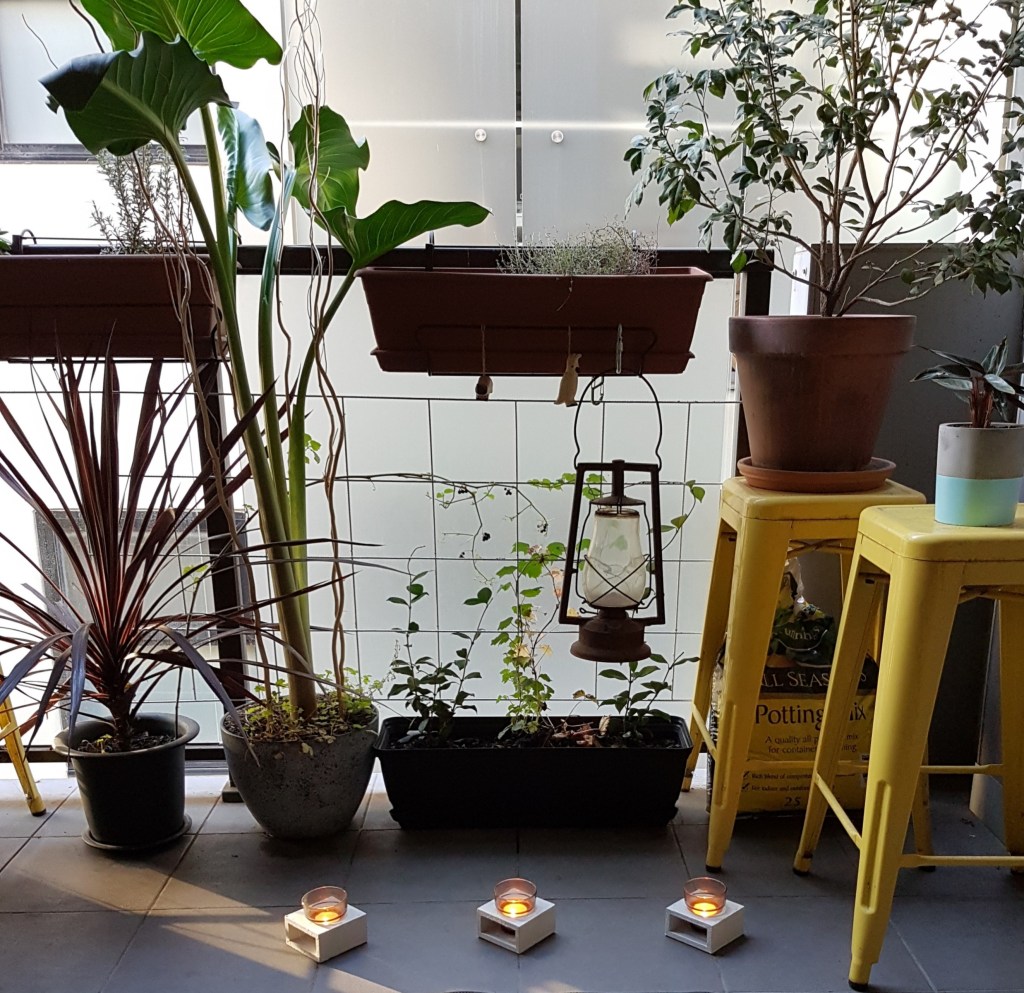
I have a small balcony, with a handful of plants that have been growing sporadically or not at all. The thyme, which has lasted for over a year, is almost dead. There is one small strand of green left on the thyme that I keep watering it, fully knowing that it will not come back to life. I just keep hoping that the coming Spring may spark magic with its warm air, falling rain and lingering sun and resurrect my thyme to life again.
I’m not writing today because I want to share the life cycle or the progress (or regress) of each of my plants. The neglect I’m reflecting on is my inability to sit with my plants and actually hear what they want. Whether they want life, whether they want death or whether they don’t want to be here at all, to return to their native home in England or to find home on the side of a river, to shed their seed and propagate their children beyond the confines of the tiny pot on my balcony. I wouldn’t know because I’m not listening, or rather, I don’t want to listen.
Across the world we are trying to gather in different, creative ways, to simulate or emulate some semblance of what church was before covid. When bodies gathered together, sang the hymns, did the rituals, drank the wine (but more often grape juice) and ate the wafer or the gluten-free loaf. When the pandemic hit the church went into a craze and instantly started recording church, capturing it with the 5 or 10 people that were allowed to be in a church. And it has been helpful for people who have never gone to church before because of geographical location, time, the commute, or maybe because of a disability, of living in a residential care home, or a myriad of other reasons. I know for our church, more people are able to engage with our feminist, social justice-oriented message that is now loaded up on YouTube every week. The church responded, got on the technology bandwagon and here we are.
But where are we really?
Throughout the last 10 years I have been saying and hearing people say that ‘the church needs to change’. And so the pandemic initially brought hope for some, it did for me: here was an opportunity to action that change. To step back, re-analyze and react to the ‘church needs to change’ sentiment. But here we are, nearly 6 months from the start of this thing, doing the exact same thing we were doing before the pandemic but now with more artistic effects and more ‘congregants’ with every like and every view, promoting (perhaps more than ever) a church to be consumed. So I’m kind choked. I’m choked that this has been the reaction, instead of tearing apart the structures of the thing before that needed to be reanalysed for ages. I’m choked the focus has not been on developing and supporting leaders within the community. I’m choked the youth and children have been neglected (if not forgotten). And I’m choked that churches reacted to the pandemic instead of reanalysed. The very thing we needed to do.
It reminds me of the joke about a priest who is stuck in this slowly, rising flood. He prays that God would come and save him. And, all of a sudden, a person in a canoe shows up and tells him to jump in the canoe. The priest, however, tells the person that he doesn’t need help and that God would save him. Then, a while later, as the waters start to rise up to the priest’s chest, someone in a boat comes along and tells the man to jump in. Again, the priest stands confidently and says he will not because he’s waiting for God to save him. So the person in the boat sails away. At this point, the water has risen up to his chin and, as luck would have it, someone in a helicopter sees his bobbing head and throws down a rope and tells the man to hold on. The priest, resilient as ever, tells the person in the helicopter, that he doesn’t need help and God would save him. The person in the helicopter flies away and the priest drowns. When he dies, he finds himself in heaven. Confused and angry he asks God, “My faith was unwavering, I trusted you, why didn’t you save me?” God shakes his head and says: “What more did you want from me? I sent you a canoe, a boat and a helicopter!”
I’m not saying that God sends pandemics to create opportunities of reform. Rather, humans tend to create environments of suffering and, because we do, we have the ability to create opportunities not only to shine a light on suffering but also to do something about it.
But what I have seen from this pandemic are churches running around like chickens were their heads cut off, trying to keep doing what they were doing before instead of realizing, in a slightly morbid way, that maybe this is an answer to prayers.
Where is the stepping back? Where is the space to breathe? Where is the sitting in the darkness and being present with its depth? With its silence? With its fear?
If this is our extended Holy Saturday, why are we rushing to (and always rush to) Easter Sunday?
Why not wade into the depth of this desire for change? To stop church as we know it, to increase pastoral care and deep listening and wonder at this canoe, this boat and this helicopter that could be a unique and one of a kind opportunity to save ourselves from ourselves.
But for now, I will try to practice what I preach and listen to the thyme, the lilies, the succulents and the rosemary on my balcony. To learn what wants to die, what wants to survive and what wants a new life, a new home, and a new existence altogether.
Musical accompaniment: Vanilla Pines, by Tow’rs
 by Rev Alisha
Leave a comment