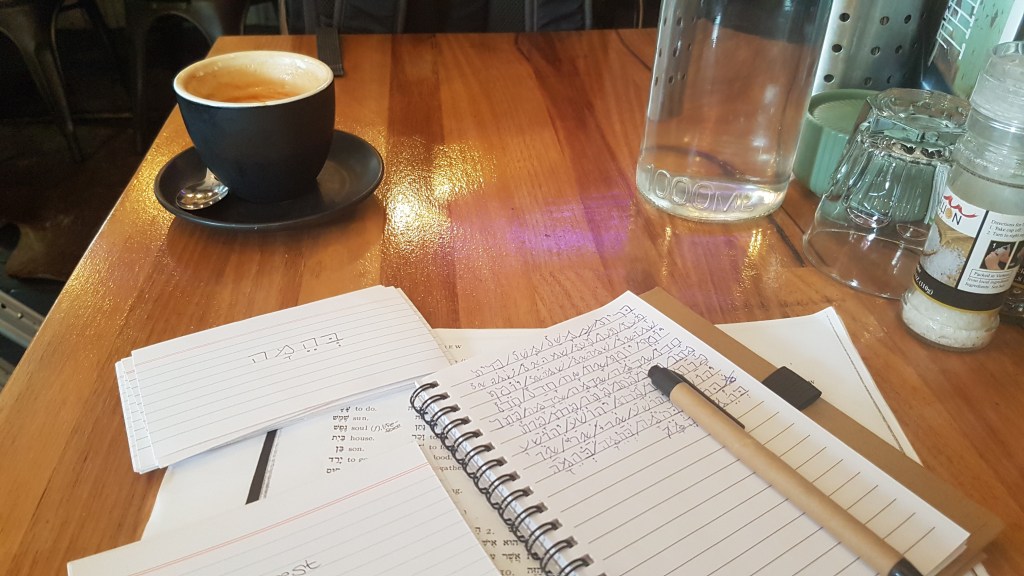
Today I find myself studying the ancient Biblical Hebrew language in a cafe, sitting next to two girls in hijabs on lunch break from the Muslim High School across the street. The waitress – a boisterous, punk, pink-haired barista – is learning French from her colleague who immigrated from France when she serves me my coffee. “What is that?!”, she exclaims, as she looks over my shoulder at the strange squiggles and symbols of my homework and I tell her I’m learning Hebrew. “Fair Dinkum!”, she exclaims as she goes back behind the coffee machine and tries out the French words she thought she mastered. I hear Arabic, colloquial Australian and French floating in the air alongside punk rock music I assume ‘pink-haired barista’ put on while my mind tries to memorize ancient Hebrew. It’s a cacophony of sounds, of lived experiences, of ancient words and wisdom, of beliefs and unbeliefs all vibrating together in one space, in one moment in time. And I can’t help but feel at one amongst the difference.
And it was only a few months ago that I felt the same kind of unitive experience. Even though I grew up in the Evangelical/Pentecostal church, I never had the gift of speaking in tongues. I saw others do it and I wondered at its strangeness and what it all meant. But it wasn’t until I went to a Kirtan Circle, which is basically singing Sanskrit mantras, when I fell into the practice most unexpectedly, surrounded by atheists and Hindus. My tongue, all of a sudden, became loose and I had a kind of out-of-body experience, enjoying the sound and feeling of my voice having a life of its own. It felt like a vibration that came from the same Spirit that hovered over the chaotic waters when the world first began. And it just made sense that this would happen in the context of people I didn’t know with varying beliefs and unbeliefs, all gathered in this place, at this time.
When I hear Acts 2 read and think of all the different kinds of people that came together, the Parthians, Medes and Elamites; residents of Mesopotamia, Judea and Cappadocia, Pontus and Asia, Phrygia and Pamphylia, Egypt and the parts of Libya near Cyrene; visitors from Rome (both Jews and converts to Judaism); Cretans and Arabs, I can’t help but think it was always meant to be this way. Despite the hardship, the tension, the differences in lifestyles and understanding, there is an inevitable ‘at homeness’ when different people come together. You can’t help but feel disoriented when you are trying to understand someone with a different language. Your world is momentarily suspended as you try to understand this person who is vastly different from yourself. And yet, there is more than you realize that makes you the same. You are both in the same place at the same time. You both drink water and eat food. You both sleep at night and work during the day. You both cry when a loved one dies. You both dance to irresistible music. Yes, you are worlds apart and yet too alike to ignore.
It is what I love about living in Melbourne. We all come from different walks of life and all have different things to contribute to this island that promised a better life for many and has the longest, surviving indigenous people, culture and spirituality in the world. There is something special in this coming together in this place at this time, something to be revered, something to be listened to. Perhaps its in the ancient songlines we stumble over without even knowing they are there – songlines that are still sung by the First Peoples of this land. A vibration that is subtly and slowly reconciling all of us from every corner of the earth, loosening tongues in the most unlikely of places, even in this place, and even at this time.
 by Rev Alisha
Leave a comment